Sales Analysis: Do More Hard Card Design Options Increase Sales?
It is easy to assume that offering more hard card designs will lead to more sales. More choices should give more customers an opportunity to find a design they like. However, an analysis of hard card sales from the 2025-2026 fiscal year found that the relationship is not that simple.
The data showed no clear, consistent connection between the number of available designs and hard card attachment rates. Agencies offering a similar number of designs often produced very different results. Increasing the number of options also did not consistently increase order value or encourage customers to purchase multiple hard cards.
In short, offering more designs does not automatically produce more sales.
Is There a Sweet Spot for Design Options?
Although the analysis did not identify one ideal number for every agency, it did reveal evidence of a practical middle ground.
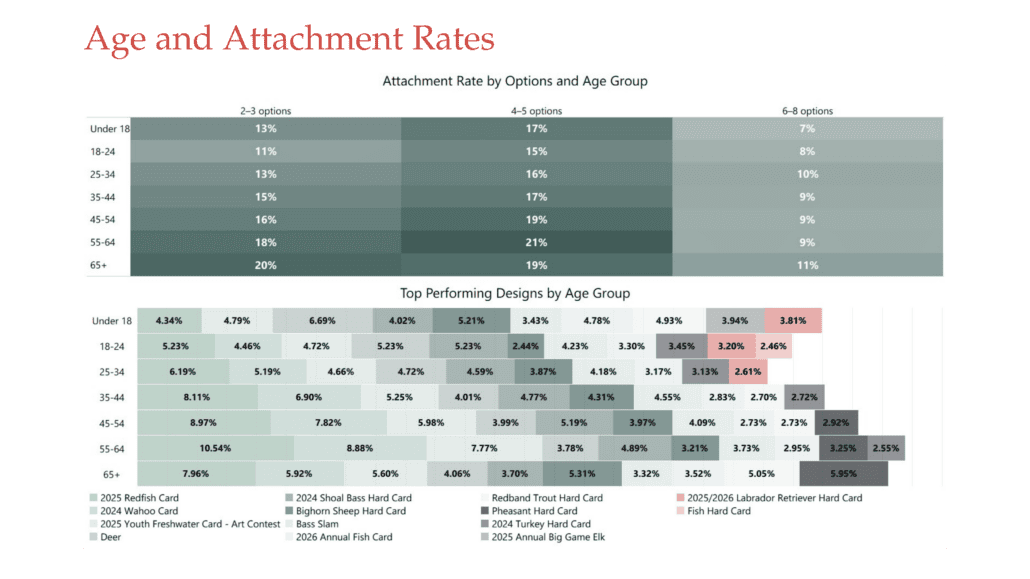
Across customer age groups, portfolios with four to five designs generally performed better than portfolios with six to eight designs. Four to five options produced the highest attachment rate in six of the seven age groups studied.
This suggests that customers benefit from meaningful choice, but too many options may not add value. A focused collection of strong designs may be more effective than a larger portfolio filled with similar or less relevant choices.
Customer Behavior Also Matters
The number of designs is only one factor influencing hard card purchases. Customer characteristics also affected attachment rates.
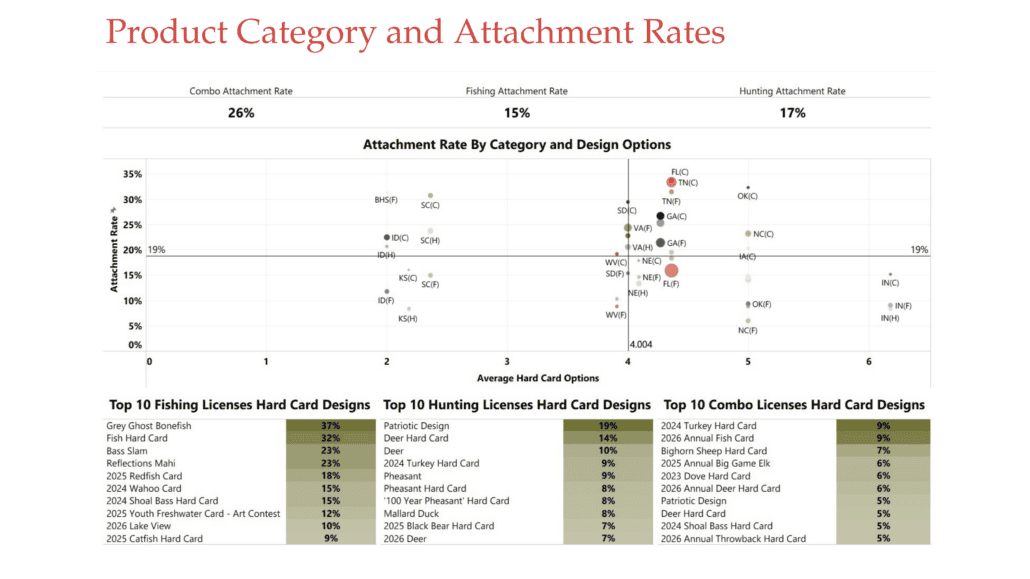
Combination-license purchases had a 26% hard card attachment rate, compared with 17% for hunting and 15% for fishing. Residents generally attached hard cards at a higher rate than nonresidents, while older customers tended to purchase hard cards more frequently than younger customers.
These differences demonstrate why the same hard card strategy may not work for every agency. The right approach depends on the customers being served, the licenses they purchase, and the outdoor activities that matter most to them.
The Design Matters More Than the Number of Designs
Individual design performance varied much more dramatically than performance based on the number of available options.
The strongest designs were not always the most detailed or artistically impressive. They were the designs that created an immediate connection with customers.
Successful designs often shared several qualities:
- Strong local or state relevance
- A recognizable species, landscape, or recreation theme
- A clear focal point
- Strong readability at hard card size
- Emotional or aspirational appeal
Context was especially important. An elk design performed exceptionally well in Idaho, where elk strongly reflects the state’s western big-game identity. A similar theme produced more moderate results in Tennessee, where elk has a more limited connection to the broader customer base.
A design can be visually appealing and still underperform if customers do not see their interests, experiences, or state identity reflected in it.
Build a More Purposeful Portfolio
The goal should not be to offer the largest possible number of designs. It should be to create a portfolio in which every design has a clear purpose.
Before adding a design, agencies should consider:
- Does it appeal to a distinct customer group?
- Is the subject recognizable at card size?
- Does it feel authentic to the state?
- Is it different enough from the other available designs?
- Can its performance be measured after launch?
Tracking attachment rates and individual design sales can help agencies identify which concepts are working and which should be replaced.
The data suggests that hard card sales are driven less by the volume of choices and more by the quality and relevance of those choices. A manageable collection of locally meaningful, visually clear designs is more likely to connect with customers than a crowded portfolio.
The data suggests that hard card sales are driven less by the volume of choices and more by the quality and relevance of those choices. A manageable collection of locally meaningful, visually clear designs is more likely to connect with customers than a crowded portfolio.
More is not always better. The right designs are what make the difference.